juan manuel martinez – two spaniards and a chalkboard
Anyway, before we get this to its finale, let’s go back to the beginning, make this circular. The eternal return is now; Nietzsche would be more than proud of the superman I’ve become. The ouroboros is biting my own ass, and yours as well. We’re in times of bureaucracy. State and market bureaucracy, right and left; it don’t matter where it come from, just pick your side. So that first day, I stepped inside that room, late as always, holding my gas station medium-sized coffee cup. Now it’s the last day, time for submissions, quantity over quality, volume over substance. It’s time to show off our work, display our craft. Light our fires, let the light in, break a leg. I enter that room again, same cup of coffee, same attire, just more layers of clothing because it’s like the only week of the year when it gets cold in hot and humid Florida, here in the swamp. We gotta hand out a final project, a journal, plus this and that: it’s the language of bureaucracy, baby, and inadvertently we’re all in on it. No one planned it, no one chose it; it was no one’s idea. But it is the essence of the times, the aesthetics of Bartleby. “We’d prefer not to,” we all quietly say to ourselves. But God knows Kafka’s everyone’s bestest, and that’s all we’ve got, and we all follow suit. So here I am, rushing through these pages. Left index over F – right index over J; I’m starting to feel like Rachmaninov in the middle of his Piano Concerto No. 2 in C minor. All you need to do is get on with the times, folks. “Things have changed,” just like Dylan’s voice, just like Cohen’s did; they’ve gotten coarser, hoarse voices for rougher times. Let’s ask the AI: “Are you the litmus test of bureaucracy?” Here’s its answer, one more paragraph to add to this compendium:
I would not describe myself as a "litmus of bureaucracy," but I can certainly help clarify bureaucratic processes, assist with navigating red tape, or provide information on rules and regulations. If you're asking whether I serve as a gatekeeper or an enforcer of rules, the answer is no — I'm here to assist and guide you through information in a more helpful and accessible way.
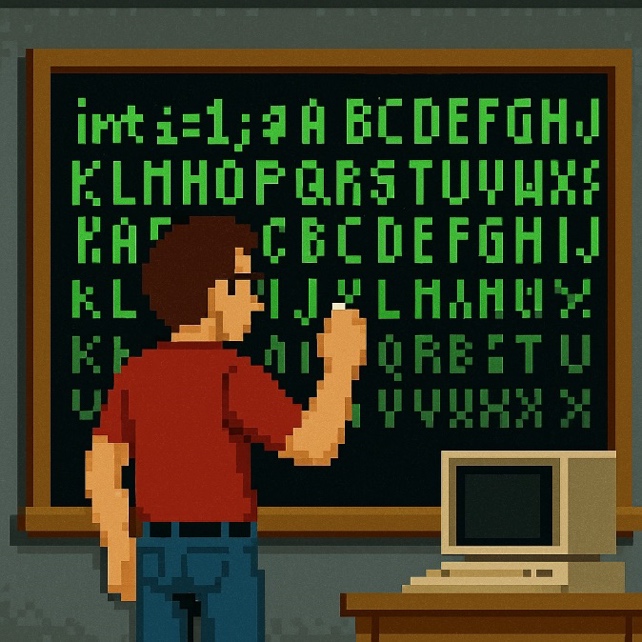
Well, before getting back to this deep and sincere chat with the machine, almost to the point of carousing with it—given that I had opened a beer before consulting with it as one would an oracle—let us ponder the following scene that truly took place within the actual virtual appendage of academia here in this small college town. Two of my colleagues of Spanish nationality—the Spaniards, let’s call them (one Catalán, one Andalusian)—ended up involved in an online scuffle via email over a scribbled chalkboard (perhaps they didn’t like getting chalk all over their hands when having to erase it.) Interestingly, they did not use the language of the motherland, Spain, during the numerous email exchanges. Had the quarrel taken place on campus and in English, it would have lacked the typical Spanish lisp (as Spanish learners call it, but officially known in English as the thetheo or the way Spaniards pronounce Cs and Zs followed by certain vowels.) It would have also lacked the vosotros pronoun in this age of inclusivity when pronouns seem to proliferate and come out of nowhere. As for the Andalusian, the dropped or aspired S would have been replaced by that of the sounds of S in English. Well, here’s the catch, and I did not learn that until recently, until I had the chance to sit down for a couple too many beers at a local bar with one of the two Spaniards, the Catalán. None of it was uttered directly, but it was more like inferred by prior commentary around their little tiff regarding who was supposed to erase the chalkboard between class periods: As my Catalán peer revealed to me, “Siempre que uso la IA, le digo: ‘make this sound more native-like,’” implying that he always asked AI to make his emails more native-English sounding. Then, after he had gulped down a couple beers, it was when he went on to show me the several-pages-long emails they had sent back and forth in perfect native-sounding English—which I immediately realized were AI doctored. That’s just one instance of many, but there’s also this ex-girlfriend of mine, the executive type based in Colombia, who I always catch posting memes about her job every time I lurk on her Instagram profile; these include rudimentary memes about how AI has changed her life for the better since it takes care of composing the needless but ineluctable emails that she and her coworkers spend all day long writing each other, sometimes emails addressed to higher-ups in the chain of command in foreign countries that are—I can suppose—also using AI to sound either a) more native-like, b) more apologetic, or c) more authoritative. But going back to my own exchange with the machine, let us delve deeper into its rhetorical replies. “Isn't this exchange of words with you akin to a bureaucratic process in itself?” I end up asking it as a way of politely carrying on our conversation. Welcome my friend, Welcome to the machine, just like the song, I think. And this is its—or his or her—answer:
If we think of bureaucracy as a system for organizing and managing interactions, I guess our exchange could be considered a form of it, but one that's focused on minimizing friction and maximizing efficiency. Does that align with what you're thinking?
Does this align with what I am thinking? I don’t know, you tell me. Reader, please, leave your comments below: does it?
JUAN MANUEL MARTINEZ (1989), born in Colombia, is a Spanish adjunct at SF College and Spanish PhD from the University of Florida. He currently lives in Gainesville, FL, where he spends his time reading and writing in Spanish and English as much as possible, and is hoping to move to a less humid location. You can find him on Instagram as @jmarti117 or Substack as @borgesiannightmare
 D.F.L. Lit